
There are feelings you’ve experienced your entire life, but never had a word for.Moments of quiet excitement. Emotional warmth. That spark when something small suddenly matters more than it should.
Some languages don’t just describe these sensations. They name them.
In this edition, you’ll discover a Filipino word English is missing, why languages build meaning like Lego bricks, and how voices from remote mountain communities are still surviving today.
Everyday Expressions
Language: Filipino - “kilig”
Meaning: A uniquely Filipino term describing the fluttery, delightful rush of excitement you feel when something romantic or charming happens; like a compliment, a smile, or a sweet moment.
Why it’s fascinating:
English doesn’t have a single word that captures kilig. We might say “butterflies in the stomach,” “thrilled,” or “giddy,” but none fully convey that mix of joy, anticipation, and emotional sparkle that kilig captures so succinctly.
Example:
Naramdaman ko ang kilig nang ngumiti siya sa akin.
“I felt kilig when he smiled at me.”
Why people love it:
Because it names a sensation everyone recognises but rarely defines so precisely. Some words aren’t just descriptive, they illuminate an emotional world.
Logic Behind Linguistics
Why Some Languages Build Meaning Horizontally Instead of Vertically
Many languages use compounding, joining two or more words to create a new concept, rather than relying on prepositions or helper words.
Examples:
German: Handschuh = “hand + shoe” → “glove”
Swahili: rafiki nzuri = “friend good” → “good friend”
Japanese: 渋谷 (Shibuya) = “astringent + valley” → place name
Why this happens:
Compounding allows languages to generate new meanings by connecting smaller, familiar pieces. It’s an efficient way to expand vocabulary without borrowing from other languages.
Instead of adding modifiers around a central word, compounding builds meaning in place, like building with Lego bricks rather than stacking blocks on top of each other.
Books We Recommend
The Cabinet of Linguistic Curiosities Yearbook: A Feast of Forgotten Words by Paul Anthony Jones
A delightful, eclectic tour of unusual words, hidden histories, and surprising linguistic facts from dozens of languages.
Why it’s worth reading:
Explores rare and forgotten expressions from around the world
Uncovers the cultural stories behind peculiar idioms
Presents language as a living, playful, surprising system
Great for anyone who loves words as puzzles, not just rules

Music Without Borders
Song Spotlight: “Yellow” by Coldplay
Though primarily an English track, “Yellow” offers a rich example of how emotion and imagery can carry a song’s meaning even without complex vocabulary.
Why it’s great for learners:
Simple, clear lyrics make pronunciation and rhythm easy to follow
Emotional imagery helps link words to feeling, a powerful memory aid
Repetition strengthens listening comprehension naturally
Shows how English vocabulary feels in melodic context
Music teaches language by experience, not just analysis. Songs like “Yellow” help your ear attune to rhythm, phrasing, and the emotional colour of expression

Endangered Languages/Voices at Risk
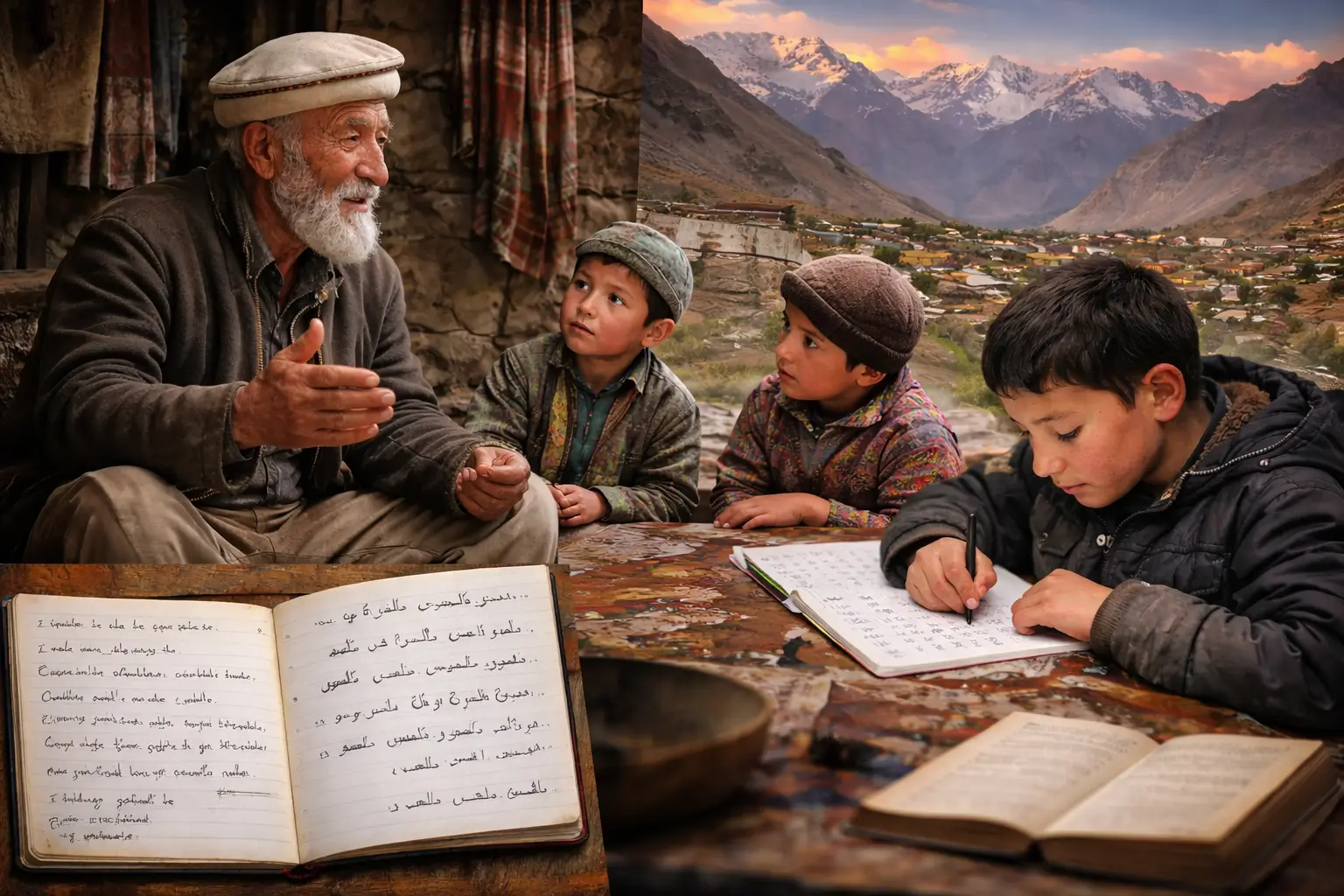
Wakhi is an Eastern Iranian language spoken in the High Pamirs across Afghanistan, Pakistan, Tajikistan and China. Shaped by mountain isolation and oral tradition, it remains a strong marker of cultural identity.
High in the towering Pamir Mountains, where Afghanistan, Pakistan, Tajikistan and China converge, Wakhi is still spoken against the odds.
Fun Facts Worth Sharing
Some languages use classifier systems, words that accompany numbers when counting specific categories of things.
For example:
Mandarin Chinese:
- 只 鸟 (yì zhī niǎo) → “one (animal-classifier) bird”
- 本 书 (yì běn shū) → “one (book-classifier) book”
Each classifier fits a category (animals, books, flat objects, long objects, etc.).
Why it’s interesting:
Instead of counting with one universal word for “one,” these languages require you to acknowledge what you’re counting. Language doesn’t just reflect reality, it classifies it.

Join the Conversation
What’s your favourite example of how language reflects culture? Share your thoughts with our community on Facebook, X, and LinkedIn.
When you share Language Learners Hub, you’re not just inviting friends. You’re helping us create more free tools and resources for everyone.
What’s possible through referrals:
Pronunciation Cheat Sheet — available now for all members.
Mini Masterclass Video Pack — coming soon.
The Polyglot’s Private Collection — coming soon.