
Happy Thursday.
"The cat drank the milk."
That order feels like logic itself. Who did it, what they did, what it was done to. How else would you say it?
Most of the world says it differently.
English is not the default setting
Linguists sort languages by the basic order of subject, object and verb. Of the roughly 1,300 languages surveyed in detail:
SOV: "the cat the milk drank" is the largest group, at around 41%. Japanese, Korean, Turkish, Hindi, Latin.
SVO: "the cat drank the milk" is second, around 35%. English, Mandarin, Spanish, Swahili.
VSO: "drank the cat the milk" around 7%. Irish, Welsh, Classical Arabic.
The remaining orders exist but are rare. Object-first languages are vanishingly uncommon. A handful in the Amazon, and linguists still argue about some of them.
So the arrangement that feels like common sense to you is, worldwide, the second most common option.
Why this matters when you learn
Here's the practical consequence, and it explains a specific frustration.
In an SOV language, the verb arrives last. In German subordinate clauses, in Japanese, in Turkish, you must hold the entire sentence in your head before you find out what actually happened.
"Because I yesterday to the shop with my brother go wanted..."
What actually helps
Read aloud without translating. Reordering in your head trains you to reorder forever.
Practise with long sentences deliberately. Short ones let you cheat.
Listen to the ends of sentences. In SOV languages that's where the information lives — and it's exactly where attention drifts.
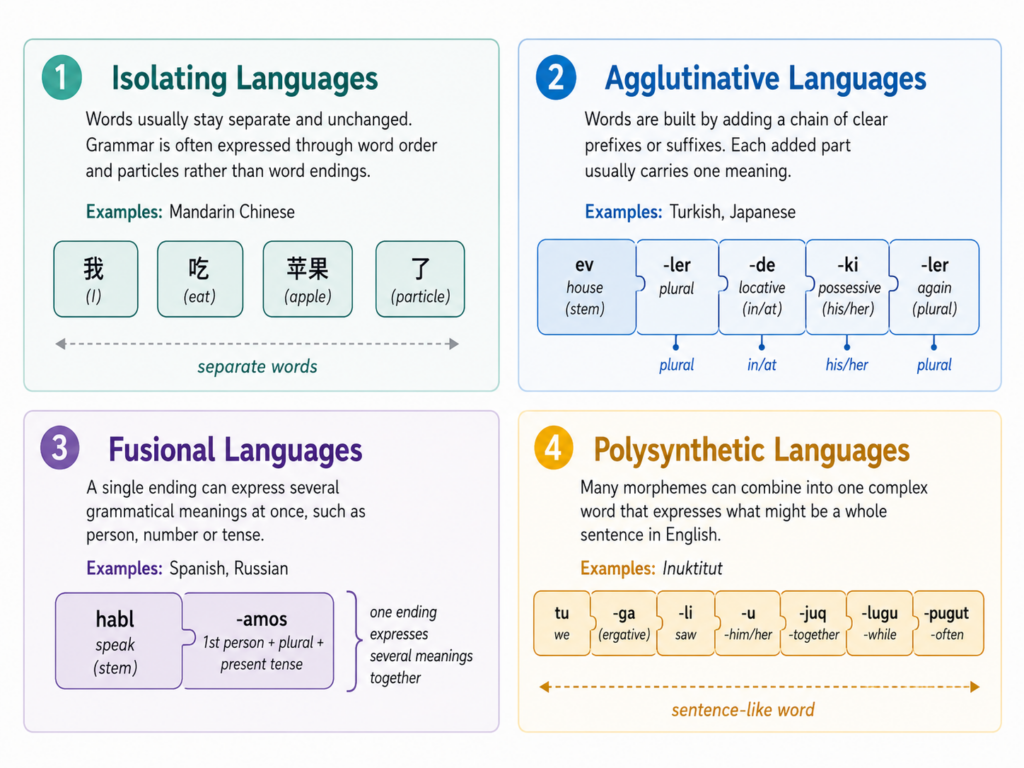
Word order is one piece of a bigger field, how linguists compare the structures of languages that look nothing alike. We've written the full explainer here.
Your turn
If you're learning a verb-final language, does the waiting still catch you out?
Hit reply, I'd like to know whether it ever fully goes away.